Why every result needs a run record
A data file tells you what happened. A run record tells you whether to believe it.
Aviation learned long ago that when something goes wrong, you need more than the outcome — you need a record of every step that led to it. Experimental science has never had a true equivalent. A result arrives as a spreadsheet; the story of how it was made lives in notebooks, memories and good intentions.
What a data file leaves out
A data file can’t tell you who ran the experiment, on which instrument, how long each incubation really lasted, or whether a step was skipped and quietly redone. Those details are exactly what you need when a result surprises you — and exactly what’s usually missing.
The Reproducibility Project: Cancer Biology showed how much this matters. Not one of the 193 experiments it tried to repeat was described in enough detail to design a replication from the paper alone. And once work began, two-thirds of the carefully peer-reviewed replication protocols still needed modifications to be completed. Small, unrecorded differences in how work is done add up.
Industry has seen the same thing. When scientists at Amgen tried to confirm 53 “landmark” preclinical cancer studies before building on them, the findings were confirmed in only six. Whatever the underlying causes, teams investing in a result needed far more than the result itself.
What regulators already ask for
Regulated labs know this well. The FDA’s data integrity guidance says records should be attributable, legible, contemporaneously recorded, original or a true copy, and accurate — the principles known as ALCOA. Nonclinical studies supporting regulatory submissions also follow Good Laboratory Practice rules on how raw data and records are kept.
Those standards describe what good evidence looks like. The challenge is producing it without burying skilled people in paperwork.
What a run record contains
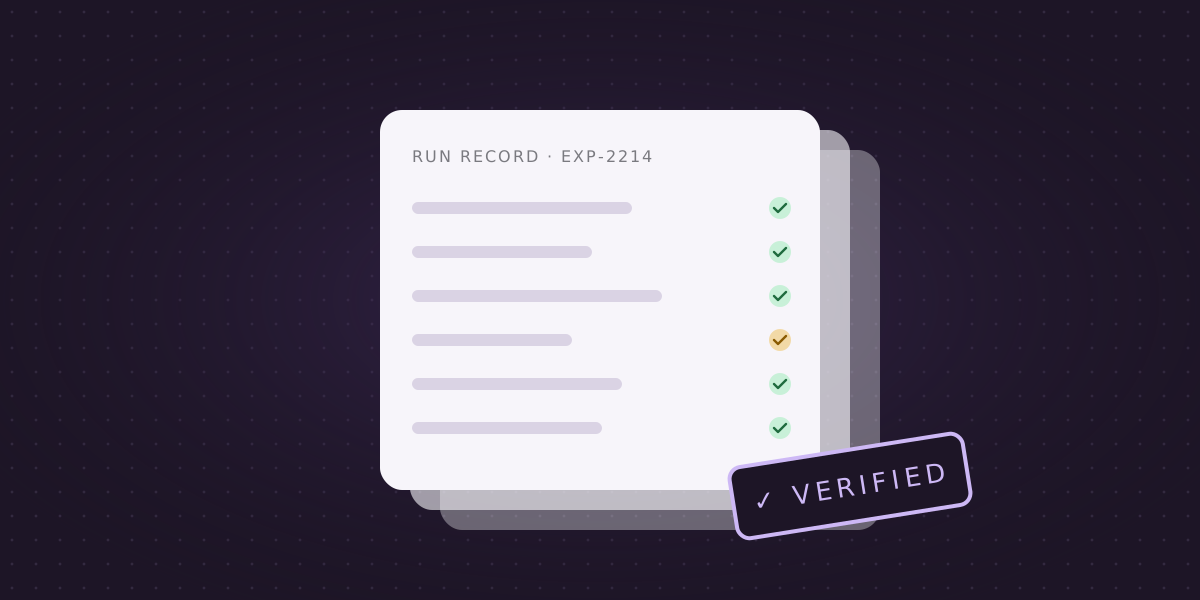
A run record is the evidence that travels with the data. At Augmentiv, every one includes:
- A step-by-step log of every action, time-stamped and mapped to the protocol line it belongs to — attributable and contemporaneous by design.
- Deviations and how they were resolved, so nothing off-protocol is hidden or quietly corrected.
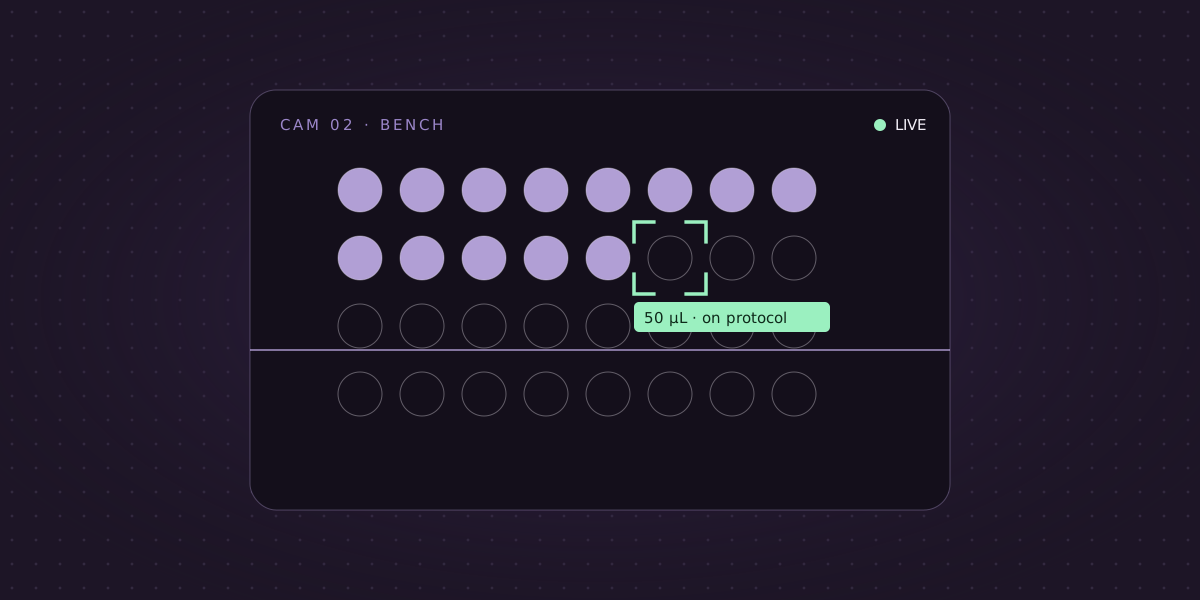
- Video evidence of critical steps, linked to the exact moment in the log.
- Instruments, materials and lab details, so the run can be understood and repeated elsewhere.
- The data itself, mapped to the samples it came from.
It’s the difference between “trust us” and “see for yourself.”
Who it helps
Scientists use the record to debug a failed run in hours instead of weeks. Quality teams use it to audit work without chasing paperwork. Collaborators and reviewers use it to reproduce results with confidence. And labs use it to show clients, run after run, how carefully they work.
Making a result repeatable
A good record doesn’t just explain the past — it makes the next run possible. When a protocol is captured as structured steps, with the timings, volumes and conditions that were actually used, the same experiment can be run again at the same lab or a different one, against the same standard. Differences between runs stop being mysteries and become things you can see, compare and fix.
That matters most when the stakes are highest: confirming a surprising result before building a program on it, transferring a method to a new site, or answering a reviewer who wants to know exactly what was done.
Where the record goes
Run records are delivered alongside the data, in formats teams already use, and can be shared with collaborators, quality teams or sponsors. Because they’re produced automatically, there’s no separate write-up to chase — and no gap between what happened and what was recorded.
The record has to be effortless
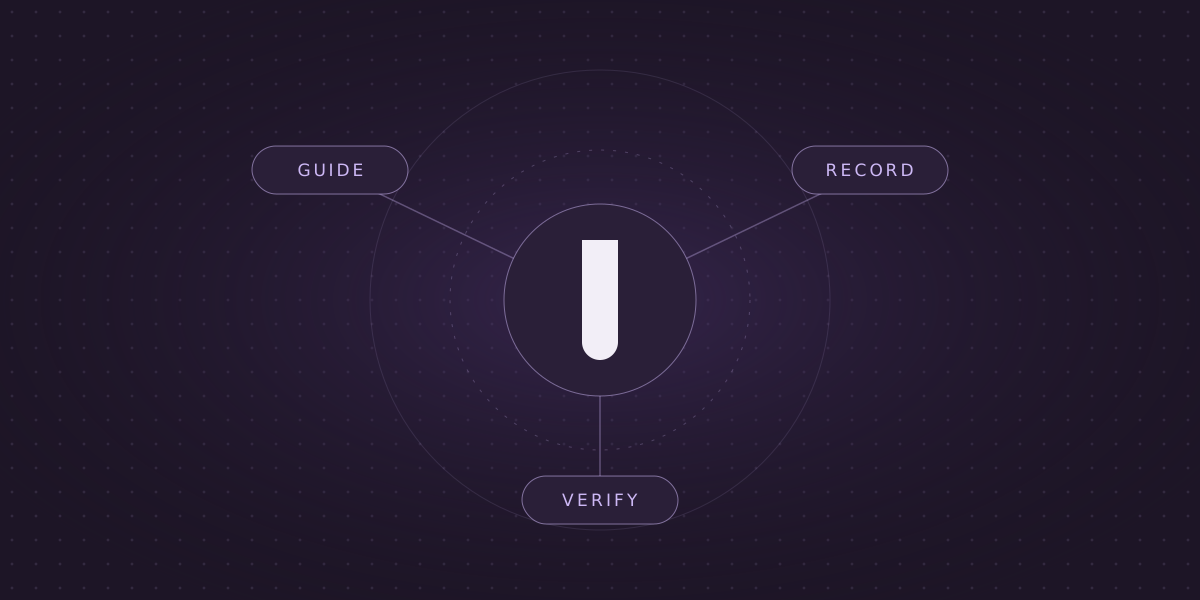
None of this works if the record is extra work. If operators have to write it, it will be incomplete — and they already spend far too much of their day on documentation. That’s why Augmentiv produces the record automatically, as a by-product of doing the work: guided on a tablet, captured on camera, verified against the protocol.
- Errington, T. M. et al. “Challenges for assessing replicability in preclinical cancer biology.” eLife 10:e67995 (2021).
- U.S. FDA. Data Integrity and Compliance With Drug CGMP: Questions and Answers (2018).
- 21 CFR Part 58 — Good Laboratory Practice for Nonclinical Laboratory Studies.
- Begley, C. G. & Ellis, L. M. “Raise standards for preclinical cancer research.” Nature 483, 531–533 (2012).